
01 · Knowledge transfer
Train or develop a team.
Prepare: profiles, number of people, components, current level, equipment and quality objective.
View the team-training frameworkProfessionals · Workshops · Manufactures
Three needs, three working frameworks. Alexandra starts from your components, constraints and expected finish: transferring a method, defining a finish or carrying out work after a feasibility study.
Three professional needs
Each route has its own process, useful information and contact subject.
01 · Knowledge transfer
Prepare: profiles, number of people, components, current level, equipment and quality objective.
View the team-training framework02 · Development
Prepare: component, geometry, neighbouring surfaces, expected result, constraints and questions to resolve.
View the technical-review framework03 · Execution
Prepare: component type, material, condition, expected finish, indicative volume and preferred timing.
View the subcontracting frameworkTraining & support
Training starts from existing practices, the company’s components and the deviations that recur during inspection. It can take place on site or in Les Brenets, with the aim of giving the team shared terminology, criteria and techniques it can continue to use independently.

Process
Alexandra examines current practices, components, available equipment and the standards to be achieved.
Exercises and corrections use the company’s production environment or the complete equipment available in Les Brenets.
Width, edge definition, surface condition, transitions and continuity of reflection are inspected directly on the relevant components.
The criteria, techniques and inspection process are expressed clearly enough to be repeated and passed on within the workshop.
In-house training case · Urban Jürgensen
For Urban Jürgensen, Alexandra built a three-stage programme: assess the needs, train the team at the manufacture, then consolidate the techniques at Art de l’Anglage.
01 · Assess
Existing skills, technical needs and quality objectives determined the content of the assignment.
02 · Train on site
At Urban Jürgensen, every correction was connected to the manufacture’s components, equipment and in-house requirements.
03 · Refine
Advanced training in Les Brenets reinforced the method, reading of reflected light, precision of corrections and consistency of inspection.
The Urban Jürgensen workshop now has full autonomy to continue this work in-house, with rigour and consistency.In-house training caseDevelopment led by Alexandra Schmitz
Finish study & development
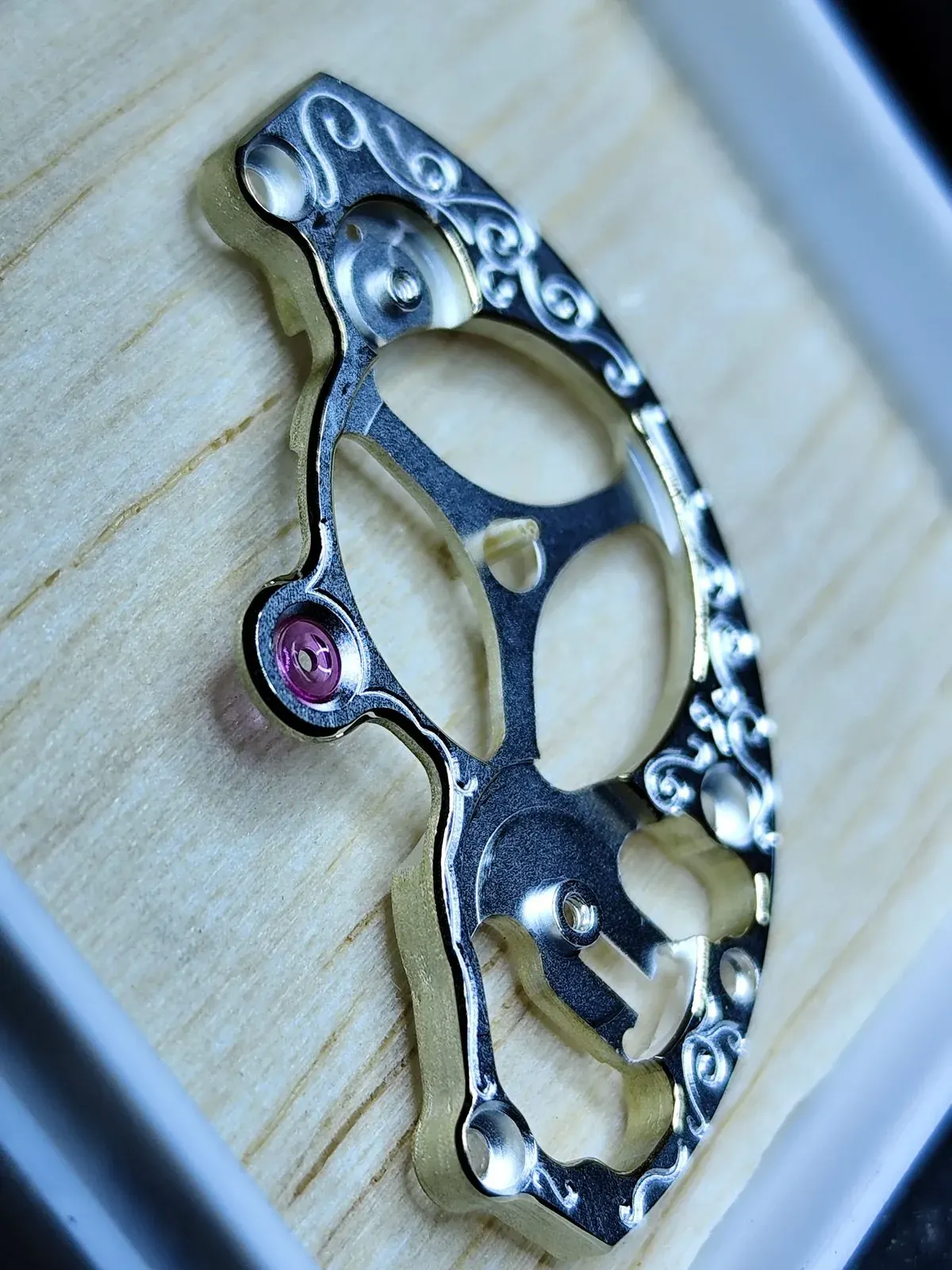
For a new component, unusual geometry or a finish level that still needs clarification, Alexandra can review the component, its access, neighbouring surfaces and expected result. The aim is to establish what is technically coherent and what still needs validation before production.
Subcontracting · professionals
Every request starts with a technical review: material, geometry, access, initial condition, expected finish, volume and timing. A proposal is prepared only once the work and its conditions are clearly understood.
Component type, material, geometry, condition and expected finish.
Access, sensitive areas, technical risks, volumes and required means.
Scope, timing and pricing are defined in a quotation for the studied request.
No client or component is published without written authorisation.
Workshop questions
Yes. Alexandra can work on site or receive the team in Les Brenets. The choice depends on components, equipment, constraints and the objective.
Every programme is built around the profiles, components, available equipment and expected quality criteria.
Through named criteria: geometry, width, edge, surface condition, reflection continuity and the ability to inspect and correct.
No client, component or assignment content is published without written authorisation. The scope can be formalised before the work begins.
Alexandra begins with a feasibility study covering material, geometry, condition, technical risks, volume and timing.
Direct contact
Choose the subject that matches your need. The form will ask for the information required for this initial review.